



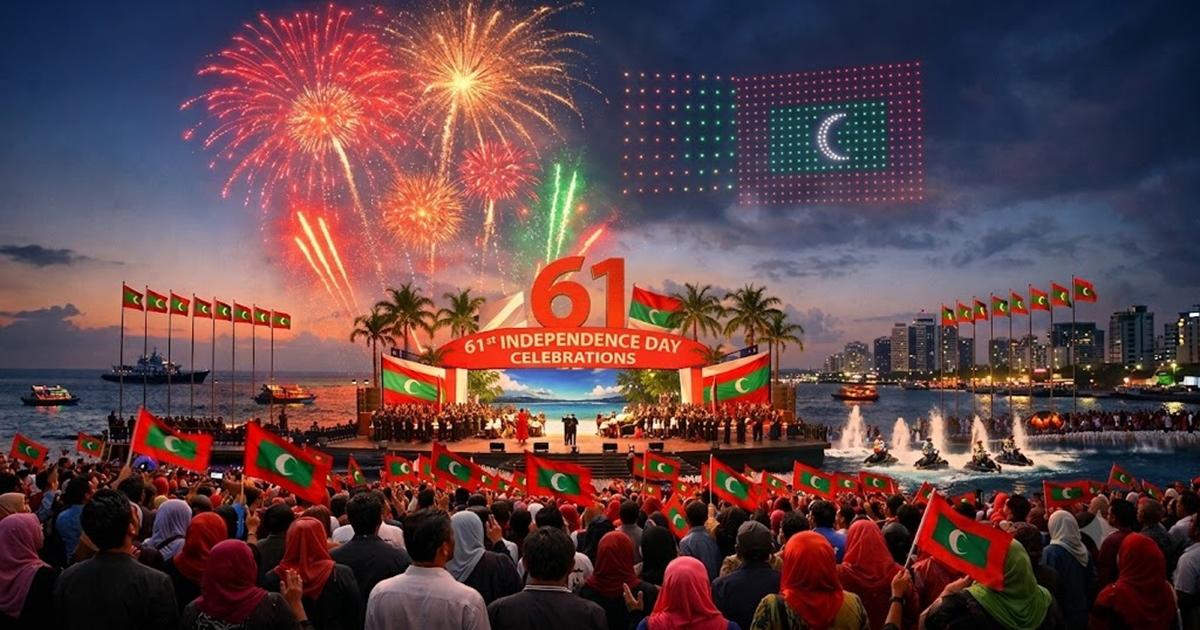
The Maldives celebrates its 61st Independence Day on 26 July, honouring the country’s freedom and the strong identity of its island communities. National flags appear across Malé, the atolls and Maldivian missions abroad as citizens remember the achievement of full independence in 1965. The occasion combines history with music, public ceremonies, cultural performances and family gatherings. It is also a day to recognise how a small island nation has built a name through its people, natural beauty and close relationship with the ocean.
The Maldives became a British protectorate in 1887, while its internal institutions continued to operate under local leadership. Full independence was secured through an agreement signed in Colombo on 26 July 1965 by Maldivian Prime Minister Ibrahim Nasir and British representative Sir Michael Walker. The agreement ended British responsibility for the islands’ defence and external affairs, giving the Maldives full control over its national decisions. Three years later, in 1968, the country became a republic.
Independence Day celebrations bring public institutions, schools, community organisations and families together. In recent years, events in Malé have included ceremonial processions, national service displays, student participation, music and performances representing different islands. Boduberu drumming adds a distinctly Maldivian sound, while traditional clothing and island customs bring colour to the occasion. The celebrations allow younger generations to learn why independence matters and how earlier Maldivians protected their national identity.
Located in the Indian Ocean, the Maldives consists of 1,192 coral islands arranged in 26 natural atolls. The islands extend for about 871 kilometres across the equator, although their combined land area is only around 298 square kilometres. About 200 islands are inhabited, while others are used for tourism, agriculture and different economic activities. This unusual geography gives each community a local character while the sea keeps the country connected.
Malé is the capital and the main centre for administration, business and education, with nearby Hulhumalé providing additional urban space. Beyond the capital area, life is spread across island towns and villages separated by lagoons and open water. Boats remain essential for travel, trade and family connections, even as domestic aviation has expanded. The traditional dhoni, adapted over generations for fishing and transport, remains a familiar symbol of Maldivian skill and seafaring knowledge.
Dhivehi is the national language and is written in the distinctive Thaana script. Islam is central to national life, shaping community values, daily routines and important celebrations. Historic coral-stone mosques show the remarkable ability of Maldivian builders to work with materials available on the islands. Local food also reflects the environment, with tuna, coconut and rice forming the basis of many well-known dishes.
Tourism is the country’s largest economic sector and supports employment in resorts, guesthouses, transport, food services and recreation. Fisheries remain central to livelihoods and national culture, particularly the harvesting and processing of tuna. Construction, communications, retail and digital services also contribute to the economy. The growth of guesthouses on inhabited islands has allowed more communities to participate in tourism.
Coral reefs are essential to the Maldives because they protect islands, support fisheries and attract visitors from around the world. The country is home to rich marine life, including reef fish, turtles, dolphins, manta rays and whale sharks. Protecting reefs, reducing waste and using marine resources responsibly are therefore national priorities with direct importance for families and businesses. Independence Day provides a fitting occasion to recognise both the beauty of the islands and the responsibility of caring for them.
The Maldives is a member of the Organisation of Islamic Cooperation and maintains strong cultural links with the wider Muslim world. Its location has also connected it for centuries with South Asia, East Africa, the Arab region and trading communities across the Indian Ocean. Cooperation with other OIC countries supports education, health, infrastructure, tourism and social development. These ties give the Maldives a voice and a circle of partners much wider than its physical size might suggest.
Young Maldivians are central to the next stage of national development. Better access to education, technical training, healthcare, digital tools and business finance can help island communities create work suited to their needs. New ideas in clean energy, marine research, sustainable tourism and online services offer useful opportunities. The country’s future depends on combining modern knowledge with the practical wisdom that has sustained island life for generations.
As the Maldives celebrates Independence Day today, it remembers the agreement that restored full sovereignty 61 years ago and honours everyone who has contributed since then. From crowded Malé to the smallest island community, the occasion expresses pride in Dhivehi language, Islamic faith, maritime culture and national unity. The red, green and white flag represents a people joined across great distances by a common home. Independence Day celebrates that bond and renews hope for a secure, skilled and environmentally responsible future.
- Business News 114
- Country News 16
- Feature News 65
- International News 235
- Interview News 36
- National News 35