



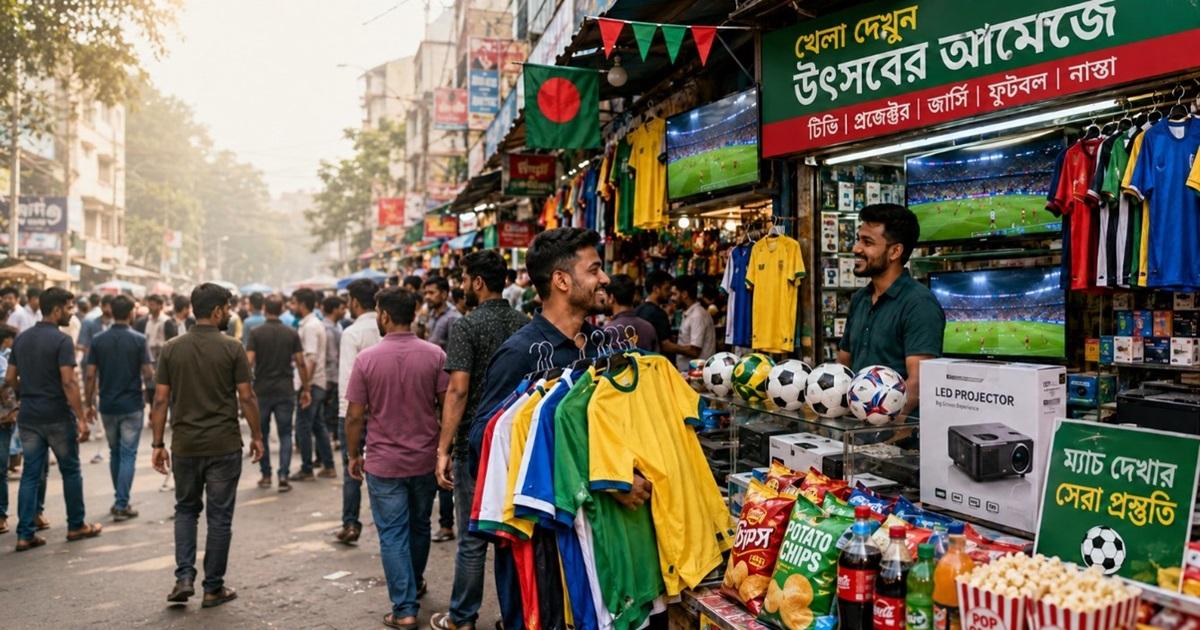
Although Bangladesh is not hosting or playing in the FIFA World Cup 2026, the tournament is already creating fresh business activity across the country. Traders say demand for jerseys, footballs, televisions, projectors, snacks, and other match-related products has increased sharply ahead of the tournament.
Business groups estimate that Bangladesh’s sporting goods sector is worth around Tk 1,500 crore to Tk 2,000 crore. Retailers say World Cup seasons usually bring higher sales than normal periods, and this year is no exception despite pressure from import costs and currency instability.
Jerseys remain the strongest-selling product. In Dhaka, Brazil supporter Nokib Hasan from Badda said he had already bought five jerseys for his elder brother, nephew, and a colleague. He said buying jerseys for oneself and for others is one of the main joys of the World Cup for many fans.
Retail stores in Bashundhara City Shopping Mall are seeing heavy customer interest. Mukul Patwary, manager of Galaxy Sports at the mall, said sales of jerseys, footballs, and other sports items have risen ahead of the tournament. He said Argentina jerseys account for about 60 percent of apparel sales, while France, Japan, and Germany jerseys are also in demand.
Patwary said the response has been better than expected, especially considering the current economic situation. Most of the buyers are under the age of 35, according to him.
Wholesale markets in Dhaka are also busy. The Maulana Bhashani National Hockey Stadium Market and the Cooperative Twin Tower Sports Market on Bangabandhu Avenue remain major centres for sports merchandise. Taiyab Hossain, proprietor of Sports House at the hockey stadium market, said fans started buying World Cup items earlier this year than in previous tournaments.
Hossain said demand has also increased for cups, medals, crests, and projectors as many people are preparing to watch matches in groups. He noted that projector prices have gone up, but buyers are still purchasing them. He also said local jerseys have improved in quality and are now closer to Chinese products because manufacturers are using better fabric.
Mohammad Khokon Gazi, a businessman at the Cooperative Twin Tower Sports Market, said Bangladeshi products are taking a larger share of the market this year. He said fewer foreign products are arriving, which has helped locally made goods sell well.
Outside Dhaka, traders are also seeing strong interest. Rangolal Talukder, general manager of SNP Sports shop in Sylhet, said business has been good so far, and he expects sales to rise further as the tournament continues. He said young customers, mainly those under 35, are driving much of the demand.
However, the market is not free from challenges. Some traders said delays in importing goods from China through the airport have affected their ability to bring stock on time. Importers are also dealing with higher costs because of exchange-rate pressure.
MR Shamim Patwari, chief advisor of the Bangladesh Sports Accessories Merchant Manufacturers and Importers Association, said this year’s business situation is different from previous World Cup seasons. He said the rising value of the Chinese RMB and the weaker Bangladeshi currency have made imports more expensive. According to him, sales before this World Cup are about half of what traders saw during earlier tournaments.
Patwari said one RMB has risen to nearly Tk 19, compared with around Tk 16 to Tk 17 a year ago and about Tk 13.89 during the previous World Cup. He added that factories producing team-specific jerseys remain cautious because such items are difficult to sell once the tournament ends. Still, he said the country’s sports goods market, including imports and local production, is worth about Tk 2,000 crore a year, and the number of factories has grown by nearly 5 percent from last year.
The tournament is also expected to support consumer electronics sales. Md Mushfiqur Rahman, head of product for consumer electronics at Fair Electronics, said the World Cup is likely to create stronger demand this year because it has come close to Eid-ul-Azha. He said demand for large-screen and smart televisions is rising, along with growing interest in UHD, QLED, Mini LED, and OLED models.
Rahman estimated that the TV market for the season could reach around Tk 1,000 crore. He said while refrigerators and chest freezers usually sell more during Eid-ul-Azha, television sales have also shown a clear rise this year.
Food and beverage companies are also expecting higher sales. Luthful Kabir Shaheen, director for business development at City Group, said demand for tea, biscuits, and snack items usually rises during the World Cup because many fans stay up late to watch matches. He said similar buying habits are appearing again this year as late-night match viewing increases.
- Business News 114
- Country News 16
- Feature News 65
- International News 235
- Interview News 36
- National News 35