



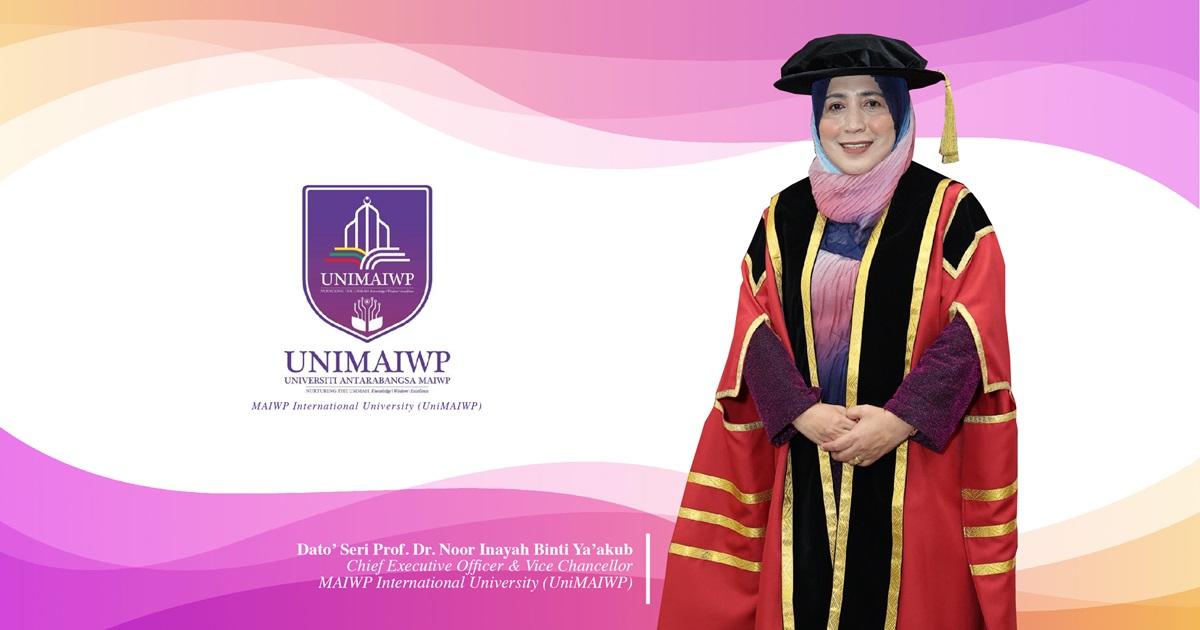
Question 1: Congratulations on UCMI’s transition into International MAIWP University. When did you receive confirmation of the university status, and what were the key strategic shifts or benchmarks that you believe made this milestone possible?
Before we were elevated to full university status, the process unfolded in two key stages. The first and most substantive milestone was achieved on 28 April 2025, when we received full approval to operate as a university under the initial name MAIWP International University. This approval confirmed that we had met all the required institutional standards in principle.
However, there was an additional and essential layer to complete—the formal online endorsement by the Ministry of Higher Education, which we received on 30 December 2025. With this endorsement in place, the elevation to full university status was formally concluded.
In reaching this point, we had to fulfil all six regulatory criteria required for university designation. These included, among others, meeting the prescribed percentage of PhD-qualified academic staff, demonstrating a strong and credible research agenda, and offering a sufficient number of accredited and doctoral-level programmes. Equally important were the standards relating to leadership, governance, and institutional management, all of which were carefully assessed as part of the approval process.
This elevation was therefore not a single event, but the result of sustained institutional readiness, academic maturity, and strong governance.
Question 2: Now that university status has been achieved, what are your top three priorities for the next 12 months—academically, institutionally, and in student outcomes?
Now that university status has been achieved, our focus shifts firmly to demonstrating excellence on the global stage. As MAIWP International University, we recognise that recognition must be earned continuously—through performance, outcomes, and impact.
One of our key strengths to date has been graduate employability. We have already reached an important milestone in seeing our graduates recognised and employed by both national and international employers. In particular, our nursing graduates are already working and contributing meaningfully within the healthcare sector, which reflects the practical relevance and quality of our programmes.
Moving forward, we are equally committed to strengthening our research capacity. As part of this effort, we have established the Institute of Renal Brain, which anchors our research direction and reflects our intention to pursue applied, impactful research that contributes to healthcare, productivity, and societal wellbeing.
In essence, our priorities now are clear: to consolidate academic quality, strengthen research excellence, enhance global recognition, and ensure that our graduates continue to be respected, employable, and impactful—both locally and internationally.
Question 3: Looking ahead five years, how do you want International MAIWP University to be positioned—regionally and globally—and which niche strengths (programmes, research areas, or industry partnerships) will you build to differentiate it from other universities
Over the next five years, my vision for MAIWP International University is for it to be recognised as a values-driven, industry-embedded, and globally connected institution, one that is firmly anchored in the Muslim world, yet respected and credible on the international stage. Our approach is deliberately focused rather than expansive. We are not interested in growth for its own sake. Instead, we prioritise depth, relevance, and real impact over sheer scale.
Regionally, I see MAIWP International University positioning itself as a leading professional university in areas where purpose, ethics, and professional excellence intersect. These include Islamic social finance, Shariah governance and ethical leadership, as well as healthcare education and practice, particularly in nursing, pharmacy, and allied health sciences. We aim to become a reference institution in fields such as zakat, waqf, and Islamic philanthropy; Shariah governance and regulatory compliance; Islamic banking, takaful, fintech, and AI ethics; and professionally accredited health sciences programmes that are recognised by global professional bodies.
What matters most to me is the kind of graduates we produce. Our graduates must be work-ready and ethically grounded, capable of stepping immediately into roles across Islamic financial institutions, trustee bodies, zakat and waqf authorities, government-linked organisations, regulatory agencies, and healthcare systems. They should leave us equipped not only with professional competence, but also with a strong sense of moral responsibility.
On the global stage, we do not intend to replicate large, research-intensive universities. That is neither our mandate nor our strength. Instead, we will differentiate ourselves as a focused global niche institution. Our strengths lie in Islamic social finance and sustainability, faith-based governance and public policy, ethical finance, ESG and impact investing from an Islamic perspective, as well as the emerging Brain–Health–Economy nexus anchored by our Institute of Renal Brain. Through this positioning, the University will act as a knowledge bridge—connecting the Muslim world with global financial systems, and aligning Shariah principles with international standards such as IFRS, ESG frameworks, and the UN Sustainable Development Goals. This allows us to be globally relevant without compromising our identity or credibility.
Clear differentiation will come from the niche strengths we choose to build. Academically, we will prioritise high-impact and specialised programmes across both health sciences and management. This includes flagship undergraduate and postgraduate programmes in nursing, pharmacy, and health sciences, alongside PhD and executive programmes in areas such as Zakat and Waqf Governance, Islamic Social Finance and Public Policy, and Shariah Governance for Financial Institutions. We will also offer professional micro-credentials tailored for bank CEOs, trustees, regulators, board members, and senior practitioners. Very few universities globally operate seriously in this space, and I believe MAIWP International University has both the credibility and the mandate to lead it.
Our research philosophy will be equally focused. We are committed to applied, policy-relevant, and industry-engaged research. Our work will be designed to influence national zakat and waqf frameworks, Islamic finance regulation and governance, and ESG, sustainability, and ethical investment models. We will establish Centres of Excellence, including in Islamic Social Finance and Governance, as well as the Brain–Health–Economy Nexus—an area that integrates healthcare outcomes, productivity, and ethical finance, and one that holds strong appeal for funders, banks, and policymakers. These centres will directly support and amplify the work of our Institute of Renal Brain.
Finally, our differentiation will be driven by the depth of our partnerships. We are not interested in symbolic MOUs. We want embedded, working relationships with Islamic banks, takaful operators, trustee companies, zakat and waqf authorities, and international institutions linked to bodies such as the IDB and AAOIFI. These partners will co-design curricula with us, fund endowed chairs and research centres, and provide access to real datasets, internships, and policy engagement opportunities. This ensures that what we teach, research, and produce remains relevant, current, and trusted by industry.
This is how I see MAIWP International University evolving—focused, principled, and purposeful, delivering impact where it truly matters.
Question 4: What Makes MAIWP International University Different and you’ve said education must serve both the mind and the soul. How will that philosophy be translated into concrete initiatives—such as curriculum design, student development, ethics and values-based learning, wellbeing support, or community impact—so it becomes a lived identity rather than just a tagline?
What makes MAIWP International University different, in essence, is focus and conviction. I believe the University must be focused enough to excel, principled enough to be trusted, and connected enough to remain globally relevant. We do not try to be everything to everyone. Instead, we are guided by strong Islamic values combined with global professionalism, by industry relevance rather than academic isolation, and by long-term sustainability driven by endowments rather than over-reliance on tuition income. By remaining disciplined in scope, principled in governance, and strategic in our partnerships, I am confident that MAIWP International University will deliver—not as a generalist institution, but as a trusted leader in values-based education, ethical finance, and professional healthcare development, serving both present needs and future generations.
For me, the idea of educating the mind and the soul is not a slogan or a branding exercise; it is an operating philosophy. If this belief is not clearly visible in our curriculum, in campus life, in leadership decisions, and in the outcomes of our graduates, then it has not truly been realised. Educating the mind and the soul means developing graduates who are intellectually capable, ethically grounded, and socially responsible. At MAIWP International University, this philosophy will be embedded systematically across academic design, student development, institutional culture, and community engagement.
It begins with the curriculum itself. Ethics, values, and purpose will be integrated directly into every academic programme, rather than treated as optional or peripheral additions. Students will encounter discipline-specific ethical frameworks—whether ethical finance in banking, integrity and governance in law, or stewardship in science and technology—alongside case-based learning that draws on real dilemmas from industry, healthcare, finance, and public institutions. Assessment will go beyond testing technical competence alone; it will also evaluate judgment, responsibility, and the ability to make decisions under ethical pressure. The mind is trained through rigour, but the soul is shaped through reflection, accountability, and moral reasoning.
Education, however, does not end at the classroom door. We will place strong emphasis on student development through a structured character and leadership pathway. All students will engage in leadership and service requirements, as well as community-based initiatives linked to zakat, waqf, social finance, healthcare outreach, and broader societal wellbeing. Graduates will leave the University with a values transcript that documents leadership roles, service contributions, and ethical development, as well as direct exposure to real social responsibility rather than simulated exercises. Our aim is to nurture professionals who ask not only, “Can I do this?” but also, “Should I do this?”
Ethics and values must also be lived institutionally. They cannot be selectively promoted or inconsistently applied. We will introduce a University Code of Ethical Leadership that applies equally to management, academic staff, and students. Promotion criteria, leadership appointments, and performance reviews will be aligned with integrity, trustworthiness, and service impact. This sends a clear and consistent signal that values are not secondary to performance, but integral to excellence.
Educating the soul also means caring for the whole person. We recognise that a healthy mind cannot flourish in an exhausted or fragmented soul. As such, we will implement integrated mental, emotional, and spiritual wellbeing support systems, alongside a structured mentorship framework that includes academic mentors, professional mentors, and values or spiritual mentors where appropriate and inclusive. Our approach will emphasise preventive wellbeing strategies rather than crisis-only interventions.
Finally, education of the soul is ultimately proven through service to society. Students and staff will contribute actively to community financial literacy initiatives, zakat and waqf advisory clinics, and ethical governance support for NGOs and public institutions. Research success will not be measured solely by publications, but by policy influence, social outcomes, and the level of trust built with communities and institutions. Knowledge achieves its highest purpose when it uplifts others.
To ensure this philosophy becomes a lived identity rather than a symbolic statement, it will be embedded into university statutes, institutional KPIs, programme accreditation requirements, and graduate attributes, reinforced through employer feedback and continuous review. We will consistently ask ourselves whether our graduates are trusted, whether they remain ethical under pressure, and whether they are serving society rather than only personal advancement.
In five years, I want employers, communities, and regulators to say this of our graduates: they are intellectually excellent, ethically grounded, and emotionally resilient. That, to me, is what it truly means to educate the mind and the soul—and that is the university we are building.
- Business News 115
- Country News 16
- Feature News 66
- International News 239
- Interview News 36
- National News 37